Three-device typing follow-up, 2026-09-25
This author-operated run continues the native editor-save campaign. It retains two failed candidates and records the repair's automated evidence and mixed-build diagnostic passes. Final acceptance with every device on the same bundle remains outstanding at this checkpoint.
- Route: isolated Compose backend, private LAN HTTPS reverse proxy for the phone, and a loopback HTTP proxy for the second desktop profile. No public route or provider service was used.
- Server: local 1.1.3 candidate from
4f5e67b, imagesha256:dca7e238bec0bb89f726e376eb1564fe8b624c16fbe6e94070b2bbea3fb207e3. - Devices: two isolated desktop profiles and one physical phone, all using Obsidian 1.13.7. Hardware models and OS versions were not recorded during these runs. Two profiles do not establish two physical computers.
- Installation: manual QA bundles in synthetic vaults. Community Plugins directory installation and production deployment are not claimed.
- Input: ordinary native key events through the desktop app and iPhone Mirroring. The phone's initial caret and first ten letters were checked visually. Final phone text was compared visually, not filesystem-hashed. The second desktop was a passive receiver throughout.
Retained failures
The active-editor retry bundle
f96e1bc1fdb32332dc448b72a75424a55670ed6c8899d18b89ca7f282822f407
failed a verified adjacent-line run: forty key events over 78.832 seconds
left Desktop: STARTABCDEFGHIJ and Phone: STARTabklmnopqrst in the main
note, with sixteen new conflict copies. It had one server head and no paused
note. A preceding attempt had uncertain input placement and is retained
locally but is not used as the verified reproduction. A phone-only control
confirmed that all twenty individual key events could reach the editor.
The first merge repair, bundle
b8a2789d6329142cc6ce02bb144cdeb44a86122cf178960e26dd7c0fd20c395f,
still failed forty adjacent-line key events over 61.099 seconds. Seventeen
new copies appeared; the final main note retained the phone's sequence but
none of the desktop additions. Later desktop input moved to the start of
the note after an external update. That was part of the observed failure,
not a successful co-typing result.
Causes and repair
Two separate paths produced false conflicts:
- After a shared merge, additions to neighboring lines formed one changed block in the line alignment. Continued independent additions then looked like overlapping replacements. Equal-length blocks are now separated into individual line edits only when every line preserves its original prefix. Actual multi-line replacements remain atomic and conflicting.
- A passive third device alternated between two independent authors. The loop detector compared each new version with the other author's previous version, so legitimate typing exhausted its budget. It now tracks the previous received version per author. Progress resets the budget only when it extends that author's branch without descending from the local publication. Feedback still reaches the existing limit. Entries whose versions leave the received graph are discarded.
Temporary instrumentation in the isolated desktop installations recorded merge inputs for the single synthetic test note and trusted-input status. It confirmed that typing protection recognized native events and that the passive receiver refused its sixth otherwise compatible merge. The instrumentation was removed before the repaired-bundle controls below; both desktop bundle hashes were verified after restoration.
Automated evidence
Repaired bundle SHA-256:
9cda676aa68087adf1e4f3eabe5b120c128fd490004fa84651ed279dd746c233.
The full make check passed with unchanged source and test hashes: 1,196
plugin tests, 70 dashboard tests, 144 core tests, 375 server tests, two CLI
tests, 767 repository contracts, 94.73% Rust line coverage and both secret
scans. One core benchmark is intentionally ignored.
Eight added regressions cover continued adjacent appends, both host paths, Unicode and unchanged anchors, structural replacement refusal, a passive third receiver on adjacent and shared lines, feedback between alternating authors, and removal of forgotten progress entries. Earlier code failed the adjacent-block and passive-receiver reproductions.
Eight new mutation controls M817–M824 and ten context recuts applied and compiled, failed relevant tests with no cancellations, and passed after restoration. M819 initially survived; an explicit competing multi-line replacement witness was added before the controls were rerun. That initial survival remains in the local evidence. M164 and M165 were also rerun against the final co-typing test file after its changes.
All 769 catalog patches pass strict applicability without fuzz. Six pristine copies each pass all 1,196 plugin tests. The full campaign is running against those frozen inputs; no complete matrix result is claimed here yet.
Mixed-build native controls
Both desktops used the repaired bundle above. The phone still used the first
merge repair, b8a2789d…. These controls locate the passive-receiver defect;
they do not establish final acceptance of the replacement phone build.
| Scenario | Result | Observation |
|---|---|---|
| Adjacent lines, forty key events over 67.328 seconds | Diagnostic pass | Both twenty-letter sequences survived in the main note; zero new copies, one server head and no paused note. |
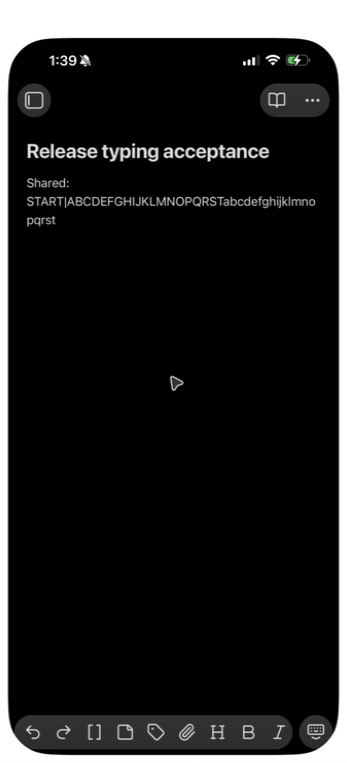
| Same line, forty key events over 62.789 seconds | Diagnostic pass | Main text was exactly Shared: START\|ABCDEFGHIJKLMNOPQRSTabcdefghijklmnopqrst; zero new copies, one server head and no paused note. |
Each sequence used individual events spaced about 1.2 seconds apart, with a visual checkpoint after the first twenty events. The timings include that checkpoint. Read-only replay of checksummed QA journal frames from sequence one independently verified each final head and its match to the desktop's record. The phone showed the same complete text. Existing copies from earlier failed runs were counted before and after; they were not mistaken for new copies or silently discarded.
Final phone installation checkpoint
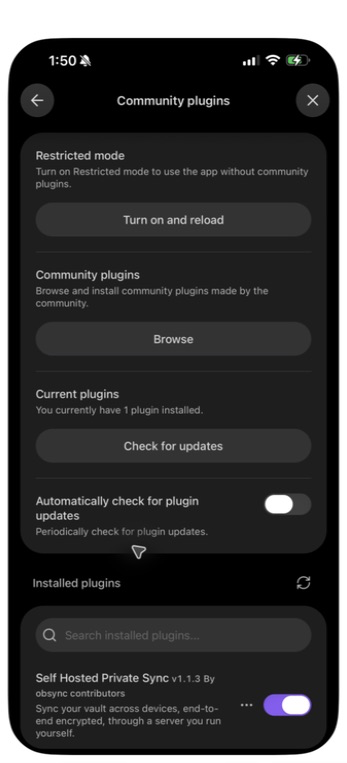
The repaired bundle was packaged in a credential-free archive and installed in a fresh synthetic phone vault. Obsidian was reloaded and the plugin's enabled 1.1.3 entry captured. The settings and empty pairing form were also captured before entering any secret. These updated screenshots appear in the quickstart; they establish the visible setup controls, not successful sync.
Mirroring subsequently stopped forwarding keyboard input while pointer navigation still worked. After a reconnect, it required the user's authentication. No successful pairing claim was observed in that attempt. Matched-build phone acceptance, the affected rewrite/Resume rerun, and final QA cleanup remain outstanding at this checkpoint.
After the user unlocked Mirroring, the same product bundle was reinstalled with the scoped rewrite fixture present but disabled. The fresh vault held two synthetic seed notes. Pairing succeeded: the approving desktop named the expected vault and two-note count; the phone confirmed before uploading them, and both notes arrived on desktop automatically. The quickstart uses these approval and confirmation captures, cropped to remove the background and masked over the private server address.
The first matched-build typing attempt was interrupted when the physical phone entered use and Mirroring disconnected. Twenty events had been dispatched, but no phone text checkpoint was possible. This attempt is recorded as incomplete, not a product failure or an acceptance pass.
The editor-budget follow-up records the later matched-build failure, the independently reproduced editor-refusal defect, its repair and the remaining acceptance boundaries.
Evidence boundaries
Screenshots preserve actual UI pixels. Public PNGs contain only mandatory image chunks, with pixel equality checked after metadata removal. No pairing code or credential was saved in these captures. Raw diagnostic records stay outside the repository.
These results do not establish Community Plugins directory installation, production deployment, other operating systems, or any unattempted scenario from the wider validation plan. Earlier run records retain their own bundle and device scope.