Editor refusal and merge-budget follow-up, 2026-09-25
This continues the three-device typing campaign. Final acceptance remains incomplete. The record below retains a failed matched-build run, two passing diagnostic replays, a separately reproduced accounting defect, and the resulting repair's automated checks. The later same-line desktop retest also failed; its passing adjacent-line control and the narrower follow-up repair are recorded below.
Matched-build typing failure
Both isolated desktop profiles and the physical phone ran Obsidian 1.13.7
with bundle SHA-256
9cda676aa68087adf1e4f3eabe5b120c128fd490004fa84651ed279dd746c233.
The server, private routes and manual-install boundaries were unchanged from
the preceding record. Two desktop profiles are still one physical computer.
The typing desktop's displayed content stopped updating while native
accessibility and saved files changed. Reopening that isolated app with
the temporary --disable-gpu launch option restored visible editor updates.
This is a QA environment qualification, not proof of a product cause or a
recommended user configuration. The user's Obsidian app was untouched.
An earlier attempt placed the desktop caret on the wrong line; it is retained
locally and excluded from the intended adjacent-line acceptance schedule.
For the verified run, a temporary character confirmed the desktop insertion point at the end of the first line. It was removed and the clean two-line baseline was verified on both devices before measurement. Forty individual native key events took 61.713 seconds, including a visual checkpoint after the first ten letters on each device. Both sequences were correctly placed at that checkpoint.
The final main note held all twenty desktop letters and only the first ten phone letters. Six new conflict copies appeared. One copy held all twenty phone letters: the input reached the device and was preserved, but the main note did not merge as required. The phone visually matched the desktop's incomplete main note. Read-only checksummed journal replay established one server head and 125 stored versions for this synthetic note; a single head does not make that result a pass.
Two later replays added temporary diagnostics only to the two QA desktop installations. The diagnostics recorded merge inputs and budget decisions for this named synthetic note, never credentials or other notes. Both passed with complete main text and no additional copies. The first took 60.422 seconds; the second deliberately allowed a twenty-second midpoint interval. They do not clear the uninstrumented failure. Its exact decision trace was not captured, so linking it to the accounting defect below remains an inference until repaired native acceptance is completed.
Reproduced accounting defect and repair
A focused probe against the unchanged candidate established a false-conflict
path without timing assumptions. Two compatible branches were presented
repeatedly while the host refused the merged write with EditorBusy. Each
refusal consumed the loop budget. The sixth attempt created a conflict copy
although none of the preceding writes had completed; allowing writes again
left the main note incomplete.
The repair refunds only an editor-busy attempt. Other errors retain their charge and the loop limit remains unchanged. Each new local edit or proven independent peer advance starts a new accounting generation. A delayed refusal cannot refund a charge from that later generation or erase another completed resolution's charge. The refund has a structured diagnostic line.
Four regressions cover eight refused writes followed by successful convergence, ordinary I/O failures, and concurrent successful resolutions with and without a new local edit. The unchanged candidate failed two of these cases. All four pass after the repair; the combined editor-retry, co-typing and new regression run passes 53 tests.
Repaired bundle SHA-256:
599770e0512d9222fa08810a03980bb690876d46977debc8bc201f2a65954aa3.
The full make check passed with unchanged source and test hashes in
240.438 seconds: 1,200 plugin tests, 70 dashboard tests, 144 core tests,
375 server tests, two CLI tests, 767 repository contracts, 94.73% Rust line
coverage and both secret scans. One core benchmark is intentionally ignored.
Controls M825–M828 all apply and compile, fail behavioral assertions with
zero cancellations, and pass after restoration. Eight inherited controls
were recut without changing their defects and likewise fail their focused
witnesses after compilation.
Native retest of the refund repair
Two isolated desktop profiles ran the uninstrumented 599770e0… bundle.
The phone was not part of these measurements. Forty individual native key
events on adjacent lines took 34.566 seconds, including a midpoint visual
check. Both main notes held both complete twenty-letter sequences. The
target's seventeen existing copies and the vault's 99 existing copies did
not increase. Checksummed journal replay found one head, 309 stored versions
and no paused note. This is a settled snapshot, not a five-minute quiet run.
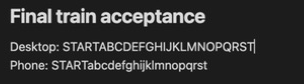
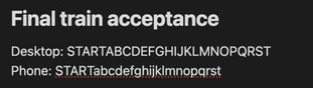
These are deterministic note-area crops of actual app captures. The word “Phone” is the synthetic fixture's line label; both captures are desktops. The retained decoded pixels are unchanged and embedded metadata is removed.
The subsequent same-line schedule failed. Forty native key events took 16.556 seconds. Both main notes retained the complete lowercase sequence, but not the uppercase sequence. Three additional copies appeared, including one with the full uppercase input. The server held one head and 327 stored versions. Preserving that input in a copy does not meet the same-line merge requirement. Temporary diagnostics were then installed only in the two QA profiles, but native accessibility reads timed out before a failing trace could be captured. The causal link below remains unproven.
Overlapping editor refusals
Eight concurrent attempts exposed another accounting case: five pending editor writes occupied the budget before their refusals refunded it. Later arrivals declared a storm and created a copy. The follow-up waits when the budget is exhausted and the host reports unsaved input or recent typing. It does not reserve another attempt or declare a storm while those refused writes are still pending. The limit and ordinary error accounting remain unchanged; the wait emits a structured decision.
A broader early-wait experiment was rejected because the full suite showed that it delayed required rewrite-conflict handling. The final change keeps the original co-typing tests and rewrite behavior intact. Two new regressions exercise overlapping refusals for unsaved input and recent typing, then require complete main-note convergence and one server head after typing ends. All 75 focused retry, budget and rewrite tests pass.
The narrower change passed make check in 228.931 seconds with unchanged
source and test hashes: 1,202 plugin tests, 70 dashboard tests, 144 core tests,
375 server tests, two CLI tests, 767 repository contracts, 94.73% Rust line
coverage and both secret scans. One core benchmark is intentionally ignored.
M829–M832 apply, compile and fail behavioral assertions with zero
cancellations, then pass after restoration. M822 and M823 were recut without
changing their defects and likewise fail their focused witnesses. Native
acceptance of this additional repair remains outstanding.
Follow-up bundle SHA-256:
8994ae22d80b22b8a9ae49220fe8af0fe1ed92fb3f2dc5fd21bcb187d952201a.
Retained ancestry beyond the recent listing
A later native replay captured the remaining failure with the insertion
points verified. The server's file listing contained ten versions. Continued
typing moved the shared ancestor outside that window while its record and
encrypted content remained in history. The client then closed a compatible
fork as unmergeable. This was not a merge-budget refusal: the trace recorded
zero merge_storm decisions. An earlier diagnostic replay placed one caret
at the beginning of the line and is excluded from append acceptance.
The repair follows omitted parent records through the existing individual version endpoint, stopping at the two branches' shared frontier. It makes at most 64 additional reads. Missing retained records or an exhausted budget discard the partial expansion and retain the existing conflict fallback; server errors remain retryable. A response cannot substitute another version or malformed parent identifiers. An incomplete current-head view does not authorize this expansion. The server API and retention settings are unchanged.
Sixteen ancestry regressions cover omitted history, transient failures, substituted records, malformed parents, cycles, ordering, incomplete graph restoration, recursive criss-cross bases and the fixed read budget. Together with the five unchanged history catch-up tests, all 21 pass. Nineteen new mutation patches (M833–M851) and two context-only recuts (M306, M716) apply without fuzz, compile, and fail behavioral assertions with no cancellations. The restored focused suites pass. The first identity-substitution experiment was manually stopped after its fake answered indefinitely; that interrupted result is excluded. A bounded fake now makes the same defect fail an assertion.
The first repair's full gate exposed two incomplete-head regressions. The
repair preserves that existing refusal without changing the old assertions.
The final make check BASE=88e8804065a27834bc671a875551a235bafbe193 passes
with 1,218 plugin tests, 70 dashboard tests, 144 core tests, 375 server tests,
two CLI tests, 767 contracts, 94.73% Rust line coverage and both secret scans.
One core benchmark is intentionally ignored. A sandbox attempt that could not
bind loopback sockets is retained separately as an environment refusal.
Both isolated desktops ran the uninstrumented final bundle:
ef030cab10b564982eb920d8781b9f8a7f5e01779395a2a1469e11553b4ddedb.
Forty alternating key events took 16.698 seconds with no midpoint pause.
After settling, both saved notes held both complete twenty-letter sequences.
The existing 32 target copies and 114 vault-wide copies did not increase.
Checksummed journal replay found one head, 446 stored versions and no paused
note. These are two native profiles on one physical laptop; they do not
establish phone acceptance. Earlier successful runs of the preceding ancestry
build remain in the local evidence as separate measurements.

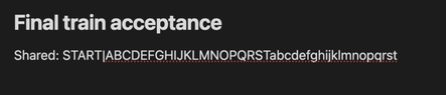
These are actual note-area crops with unchanged retained pixels and no embedded metadata. The exact final bundle was downloaded to the phone in an eight-file archive containing no credentials, installed only in the synthetic two-note vault, and reloaded through Community plugins. Its pairing remains incomplete. The initial test address used an IP while the QA proxy certificate covered a hostname; the resulting TLS refusal was correct. The address was changed toward the existing certificate's hostname without changing trust or restarting the server, but its saved value was not successfully verified. Later inspection found a mistyped port, and another UI entry visibly dropped characters. Safari reached the QA server over trusted HTTPS; Obsidian's iOS Local Network permission was verified enabled. The unsuccessful pairing is therefore not evidence of a plugin networking defect. Mirroring pointer failures and unreliable text entry blocked final phone acceptance. All five superseded ZIP downloads were removed through Files; the final ZIP, synthetic vault and final cleanup remain outstanding.
The final full mutation campaign contains 796 patches, all strictly applicable
to this source. Twelve concurrent pristine baselines exposed load-sensitive timing failures
in watcher, refusal-republish and folder-rename tests. Those logs are retained;
no mutation outcome was counted from that attempt. The campaign was reduced
to six isolated copies with identical tests and assertions. Its result is pending, and MATRIX.md remains historical. The preceding
777-control run stopped after 258 completed sections with all six source
copies restored; it is not evidence of final-campaign completion.
Mutation recording
The preceding 769-control campaign stopped when M518 reported 21 failures but the output filter retained only eighteen names. Three failing nested tests were indented and omitted by the filter. The final stopped snapshot contains 285 completed sections, with all six source copies restored. It is retained as partial evidence, not a complete matrix result.
The runner now retains indented failure lines and the recorder reads them.
All 773 patches at the refund repair passed strict applicability without fuzz. Six pristine
copies each pass the 1,200-test suite before the new frozen-input campaign.
That campaign was later paused at 179 completed sections after the native
same-line failure above, with all six source copies restored. It is partial
evidence; MATRIX.md remains historical until a complete final campaign.
A later Mac restart interrupted six in-flight controls after 61 completed sections. The completed logs and interrupted source copies were preserved. All frozen inputs still matched the author tree. The six modified source files were restored to those hashes, and the campaign resumed from the first unfinished control in each lane. This was an environment interruption, not a measured mutation outcome. M518 subsequently retains all 21 failure names, including its three nested failures: 1,179 pass, 21 fail, zero cancelled or skipped, and 1,200 tests measured.
Repaired phone installation
Both isolated desktop installations received the uninstrumented refund repair before the retest above. The same bundle was downloaded to the physical phone in a credential-free archive and installed in the synthetic two-note vault. The plugin is enabled; the scoped rewrite fixture remains disabled.
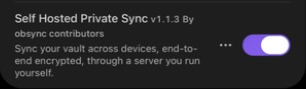
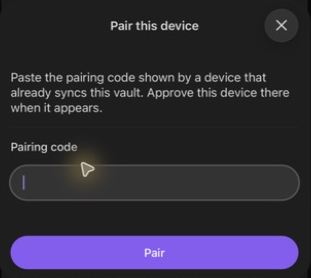
These captures show the actual setup controls. Deterministic cropping removes unrelated settings and the background; metadata removal preserves every remaining pixel. No pairing code was captured. Mirroring locked during the subsequent UI-only code transfer and no claimant was confirmed. Pairing and native acceptance remain incomplete.
Cleanup removed ten inactive QA directories or files, including the old server-recovery copies and unused isolated apps and vaults. Their measured receipts and screenshots remain available. The active desktop profiles, phone artifacts and QA containers are still needed for final acceptance and remain pending cleanup. A further eighteen inactive rig instances and their old QA symlinks were removed after process and mount checks, reclaiming about 12.7 GiB. Their reports, screenshots and logs were retained. The user's vaults were not involved.
Earlier current-bundle desktop rewrite control
Before the editor-budget repair, the 9cda676a… bundle passed a scoped
two-desktop rewrite hold lasting 303.457 seconds across eleven samples.
Both timestamp fixtures kept changing their local note while the server
stayed at four versions and one head, with no conflict copies.
After both fixtures were disabled, the passive desktop resumed first and the typing desktop second. Both retained all twenty typed letters and one identical preserved copy. Eleven post-Resume samples over 303.474 seconds showed stable main and copy hashes, five stored versions, one server head, no paused note and both fixtures disabled. Both isolated apps had been gracefully reopened after UI-control timeouts before Resume; uninterrupted app lifetime is not claimed. A later misdirected search-text insertion took place after sampling ended and is excluded from these measurements.
This was a desktop control. It neither exercises the phone's rewrite
fixture nor establishes acceptance of the subsequent 599770e0… bundle.
Its phone typing and rewrite/Resume checks, complete mutation campaign and
final removal of synthetic QA artifacts remain outstanding.
Handoff cleanup checkpoint
The user ended this QA session for a clean handoff. Both isolated desktop apps were stopped; their two synthetic vaults, profiles, old bundle backup and download-serving directory were removed. All four active QA containers and their four disposable volumes were removed and verified absent. The measured manual results above, including failures and exact bundle hashes, remain the acceptance evidence; the deleted fixtures are not prerequisites for reproducing them on another machine.
The final synthetic phone vault and ZIP were subsequently deleted through Files. Downloads showed only the user's preserved document, and the Obsidian folder showed only the user's two vaults. QA certificate/secret references and Safari QA entries remain pending; complete phone cleanup is not claimed. Recently Deleted was not purged. The user's vaults were not touched. A new phone run must create fresh disposable fixtures, verify the saved endpoint and port before pairing, and repeat the affected typing and rewrite/Resume journeys on the final bundle.
The 796-control campaign reached a clean 196-control checkpoint with no
unexpected outcomes. All six source copies were restored at the handoff
pause. This is a partial count, not a passing matrix. The existing runner
and its completion records are the authority for later progress; do not
replace the historical MATRIX.md until the complete measured run passes.