Native phone candidate 1.1.3, 2026-09-24
This author-operated campaign uses a separate synthetic phone vault and an isolated desktop profile. It follows the 1.1.2 phone run and does not replace that historical record.
- Route: the existing LAN HTTPS reverse proxy and previously trusted test certificate on the phone. No system trust setting was changed in this run. The desktop uses a loopback-only HTTP proxy to the same isolated backend.
- Server: local 1.1.3 candidate built from
4f5e67b, imagesha256:dca7e238bec0bb89f726e376eb1564fe8b624c16fbe6e94070b2bbea3fb207e3. The old server volumes were backed up before recreating the backend; the existing HTTPS front and volumes were retained. - Plugin: manually installed 1.1.3 candidate, bundle SHA-256
fcb6f3dbd45120d615a5ce6da6be63d4f7ccce0f8548dce27ead7d8f89f4b482. This includes the later #133 replacement-boundary repair. The public-code archive SHA-256 isf0b486dd1d35df2333df283cad36b107355fc3b13104d31ff60c6faed6c98270. It contains no enrollment, credential, token or vault key. - Devices: desktop Obsidian 1.13.7 on macOS 27.0; phone Obsidian 1.13.7. Hardware models and phone OS version were not recorded during this run.
- Operation: native UI through iPhone Mirroring and the isolated desktop app. The archive contains one synthetic note and a disabled rewrite fixture limited to that note and its conflict copies. No injected Obsidian API drives user actions.
Installation observed
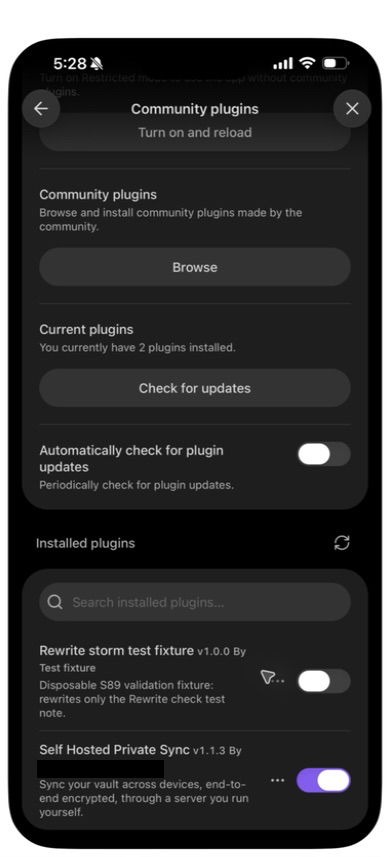
Safari downloaded the archive. Files moved it into the local Obsidian folder and extracted it using Uncompress. Manage vaults found the new vault; opening it displayed the author-trust prompt below. The known local test bundle was enabled, and Community plugins showed version 1.1.3. The rewrite fixture remained disabled. This manual candidate path is not a result for installation through the production Community Plugins directory.
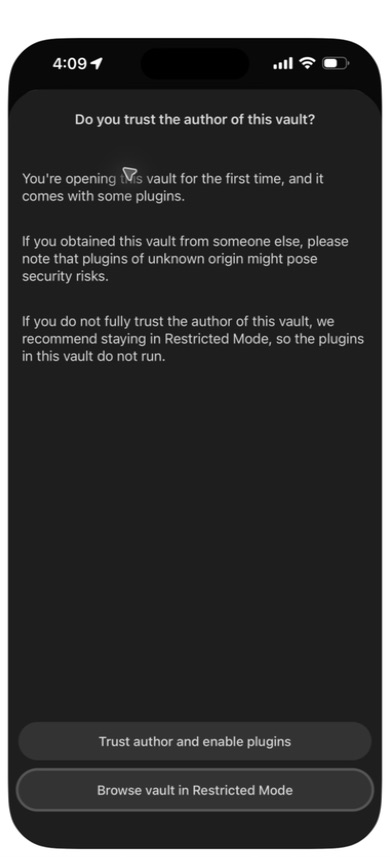
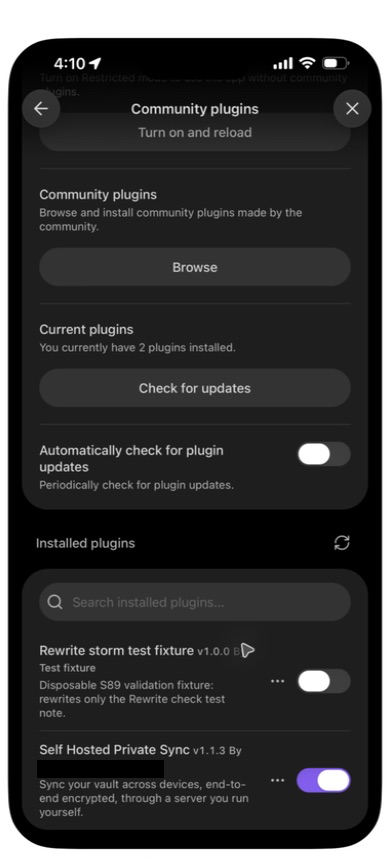
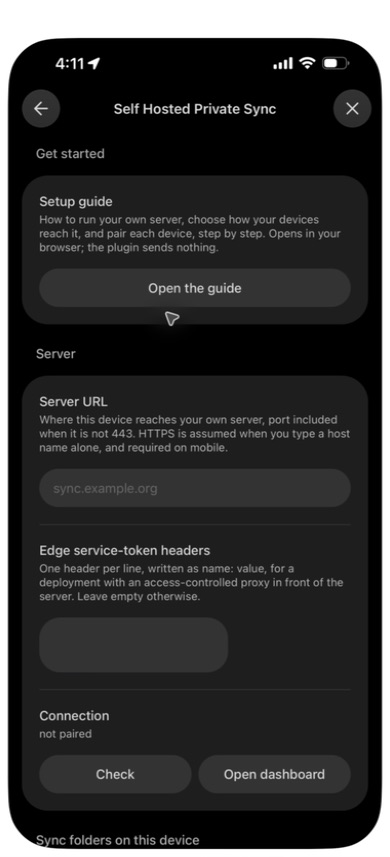
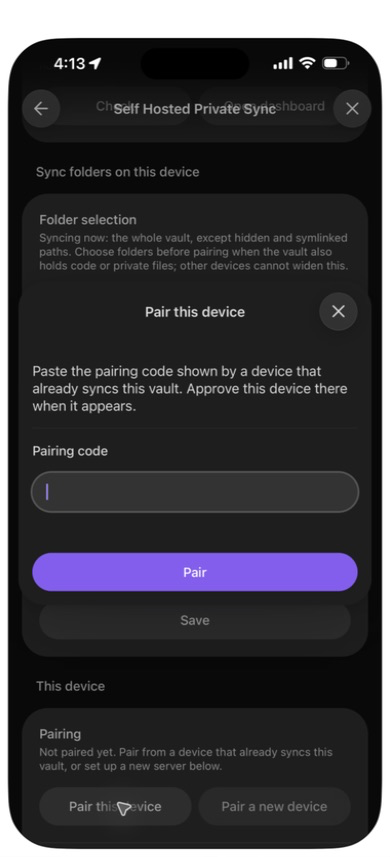
The screenshots above belong to the initial installation. The final candidate was installed and paired in the follow-up below. No pairing code, setup token, recovery phrase or private connection detail appears in the published captures.
Final candidate installation and pairing
The unpaired test vault was replaced through Files with the final candidate
built from cba9eec021c11bdba0adce97d0c6f50ce3b97259. Its bundle SHA-256 is
72495e0339faa22817684baff95a38b696cbdd9ac3915a0baf76617c4c0ff211;
the archive SHA-256 is
0ccb6612f22a88860615378ac0d06f23f51aa6dfb5b4c9a196ec7451b5ce1512.
The archive contains the plugin, one synthetic note and the disabled fixture,
with no credentials or enrollment data. The desktop uses the identical bundle.
The phone retained its prior trust choice for this synthetic vault path; this
replacement did not display a second author-trust prompt.
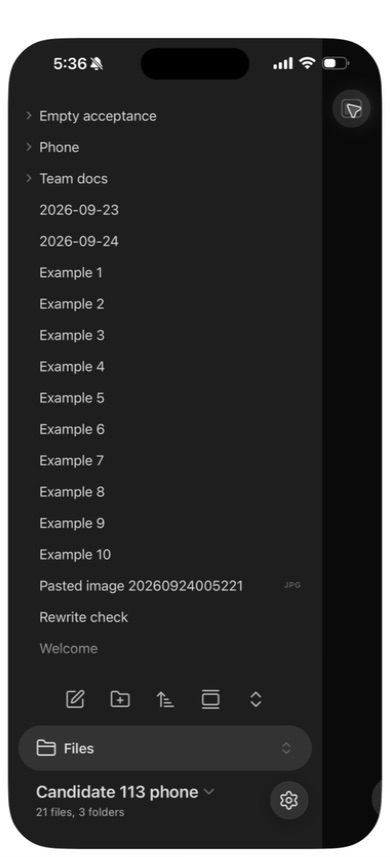
The phone's Check reached the existing QA server over HTTPS. With the user's explicit approval, a one-use invitation was transferred from the desktop through native key presses and temporary memory only. It was never printed, saved or captured. The desktop approval named Candidate 113 phone, reported 1 note, and identified plugin 1.1.3. After approval the phone showed 21 files and three folders, matching the desktop, without conflict copies.
A line typed on the phone arrived in the desktop editor. The desktop reply then appeared in the phone's still-open note. Neither direction used Sync now. The phone contents were visually verified; no phone-filesystem hash is claimed.
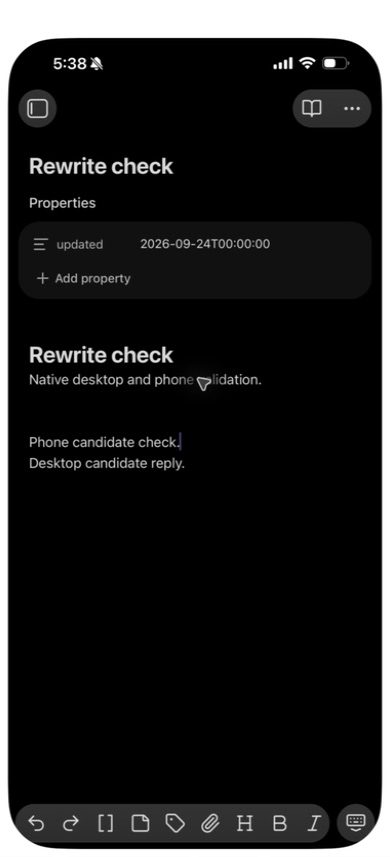
Rewrite hold on desktop and phone
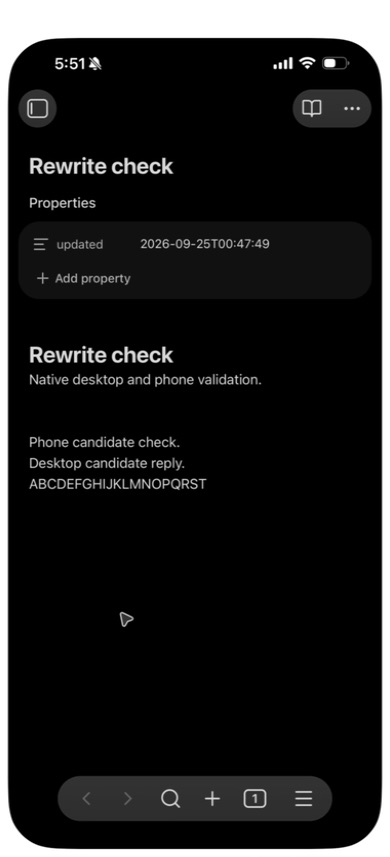
Both native editors opened the same synthetic note. Each enabled the scoped
one-second front-matter fixture through Community plugins. Twenty letters,
ABCDEFGHIJKLMNOPQRST, were typed on desktop through native keys with a
500 ms delay after each key. The phone detected repeated rewrites and the
desktop received the shared hold. All twenty letters remained together in
the desktop main note, while the held phone note contained its earlier ABCD.
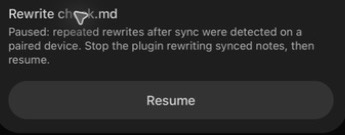
The phone's Show sync status named the paused note and offered Resume.
Eleven samples over 301.45 seconds found no new note-version POSTs,
no copies, a stable desktop file record and all twenty letters intact. Local
timestamps continued changing, showing that the fixtures were still active.
There were four version POSTs between the pre-typing baseline and the first
hold sample, counting this otherwise idle QA account's version requests.
Both fixtures were disabled through Community plugins; their disabled state
was verified. Resume on the phone completed, followed by Sync now on
the desktop. Both main notes contained all twenty letters and exactly one
conflict copy remained. The desktop main SHA-256 was
bb7b67b6d11ea381c6c6562087bce4052a8a7b6a11f9039d1adac85662a9c318;
the copy SHA-256 was
1091018a831d27d1057b97194569437cffdc5915cf69c21efdef27f4f609ed62.
Phone contents and copy count were visually verified, not filesystem-hashed.
Eleven further samples over 301.44 seconds found zero new version POSTs, stable desktop note and record hashes, one copy and no hold. The phone still showed the full typed sequence. This passes the exercised desktop/phone S89 case on this bundle. It does not establish every mobile timing, every plugin's rewriting behavior, or the opposite native Resume order. Both orders remain covered by the automated suite.
The local receipts are 113-phone-rewrite-hold.json,
113-phone-rewrite-quiet.json, 113-phone-rewrite-resume-result.json and
113-phone-rewrite-typing-times.json.
Ordinary co-typing
With both fixtures disabled, desktop and phone edited separated lines of a fresh note. A rapid, unpaced key-injection attempt changed the intended digit sequence and is retained as a failed test input. A phone-only rapid control, with the desktop idle, also changed it; paced phone input preserved it. These rapid attempts do not count as passing co-typing evidence or establish a sync root cause.
The retry alternated native desktop and phone key presses with 500 ms after
each action. Both main notes converged with the complete desktop sequence
ABCDEFGHIJKLMNOPQRST and phone sequence 12345678901234567890, with zero
conflict copies. The desktop note SHA-256 was
e3b2341f67ec9051dbe0d9138d3b1a232bbcaffb558b5aa5dfe85bad191a822b.
The phone result was read in its native editor. The exact dispatch times and
both failed and passing controls remain in the local evidence. This tests
interleaved real-device input at the recorded cadence, not simultaneous
physical key presses or an injected network delay.
Remaining automated acceptance failure
The subsequent six pristine full-suite runs passed five lanes, but one failed
the separate automated co-typing case: after repeated concurrent merges,
B012 remained in a conflict copy rather than the shared main note. Each
device converged on one main version and one copy, but that does not meet the
separate-line typing requirement. The mutation matrix remains paused while
this failure is diagnosed. The native observations above stand only for their
recorded inputs and cadence; they do not clear this failing schedule.
The subsequent publication-order follow-up records the repair and its focused stress evidence. It does not replace the affected native acceptance gate for the new bundle.
The later phone timing follow-up records the timing candidate's native typing and rename results, along with a distinct historical-conflict replay failure found during fresh pairing.