Account recovery, 2026-09-24
The user selected setup-token plus vault-key-proof re-enrollment for #142. The implementation derives a separate authentication proof from the vault key using the existing HKDF-SHA-256 primitive and a new protocol label. The server stores only its SHA-256 verifier, immutably, in the account journal and snapshot. The derivation follows RFC 5869; its exact inputs and credential trust boundary are in the protocol and threat model. This is an author implementation record, not an independent security verdict.
Real-server regressions exercise authenticated registration, wrong-token and wrong-proof refusals, last-device revocation followed by re-enrollment, the same account and retained ciphertext, and continued refusal of the revoked credential. Storage tests reopen both journal and snapshot state and reject malformed stored verifiers. An unregistered legacy account remains fail-closed. A registration cannot be retroactively inferred after all old credentials were lost; the recovery guide states that upgrade boundary explicitly.
Plugin regressions cover first setup, a lost setup response, durable key storage before enrollment, single-flight setup, key replacement during either network or derivation waits, old-server compatibility, forgotten credentials on startup and feed, sticky status, resetting after old writers drain, local note/key/address preservation, direct revocation, two devices leaving in order, pairing from a forgotten identity, and both paths of the server-switch dialog.
All 30 new plugin probes, M580–M609, compiled and were killed by the focused
behavioral suites. The first 28 used 114 tests; the final two used 116 after
adding their specific race regressions. The 15 server probes also compiled and
were killed; reproduce them from the repository root with
python3 scripts/validation/account_recovery_mutations.py. Plugin probes are
reproducible individually with the existing full-suite mutant runner. Final
full-matrix evidence belongs to the final composed release head.
The full make check passed after updating the onboarding mutation fixture
for the renamed button: 144 core tests, 373 server tests, two CLI tests,
988 plugin tests, 70 dashboard tests and 767 contract tests. Rust line
coverage was 94.69%; both secret scans reported no leaks. The core suite
retains its existing ignored test.
After composition with #141 and #178, make check also passed: 144 core,
375 server, two CLI, 1,001 plugin, 70 dashboard and 767 contract tests;
Rust line coverage was 94.73%, with no secret-scan findings.
Native S14, S39, S40 and S41 journeys and setup screenshots remain separate acceptance work. No native result is inferred from these automated tests.
Native desktop recovery
An unmodified Obsidian 1.13.7 application used an isolated synthetic vault and
profile. The plugin bundle was built from the standalone #142 commit
90a600e (SHA-256 897cc17ee059ddaee7de5eb106b52a058c3a0d7733288032bc91efde6f01c850);
the local test server used the composed 71c6d98 recovery implementation.
UI actions used the native interface; no injected Obsidian API drove them.
- A previously forgotten device showed the recovery explanation and action.
The existing vault key and every local note remained available.
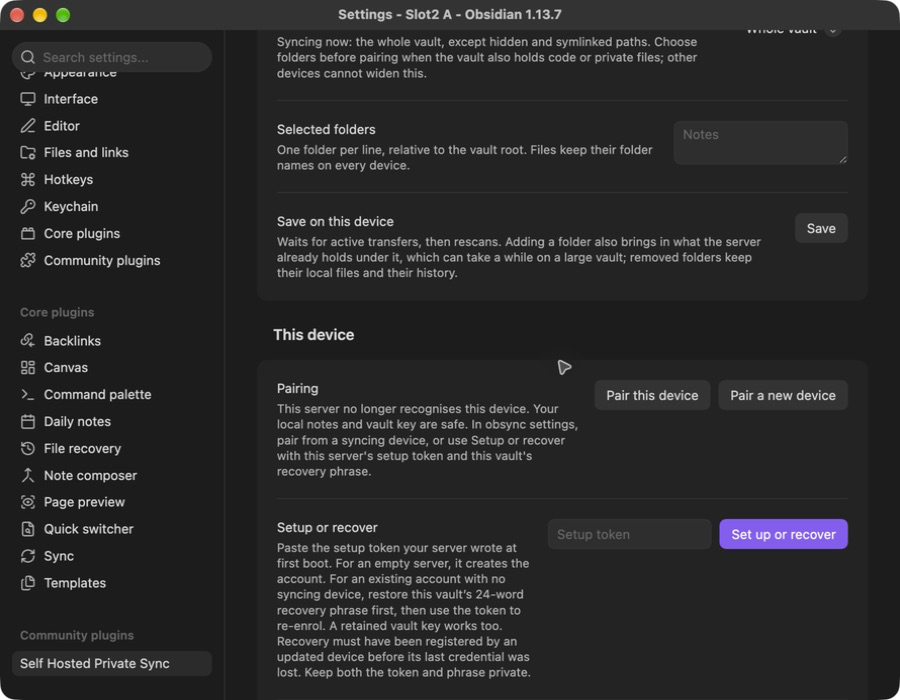
- Setup on the isolated server enrolled the vault and uploaded 217 files.
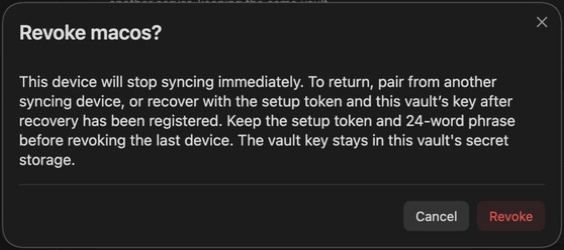
Revoking its sole device showed the explicit recovery warning below, with
Cancel focused first. The server accepted revocation because recovery had
been registered. No token or phrase appears in these captures.
- Entering that server's setup token under Set up or recover, with the
retained vault key, displayed Account recovered and this device re-enrolled.
Sync returned to idle. The replacement identity was different, while
all 217 local file hashes were unchanged and all 217 sync records returned.
The device list retained the previous device as revoked.
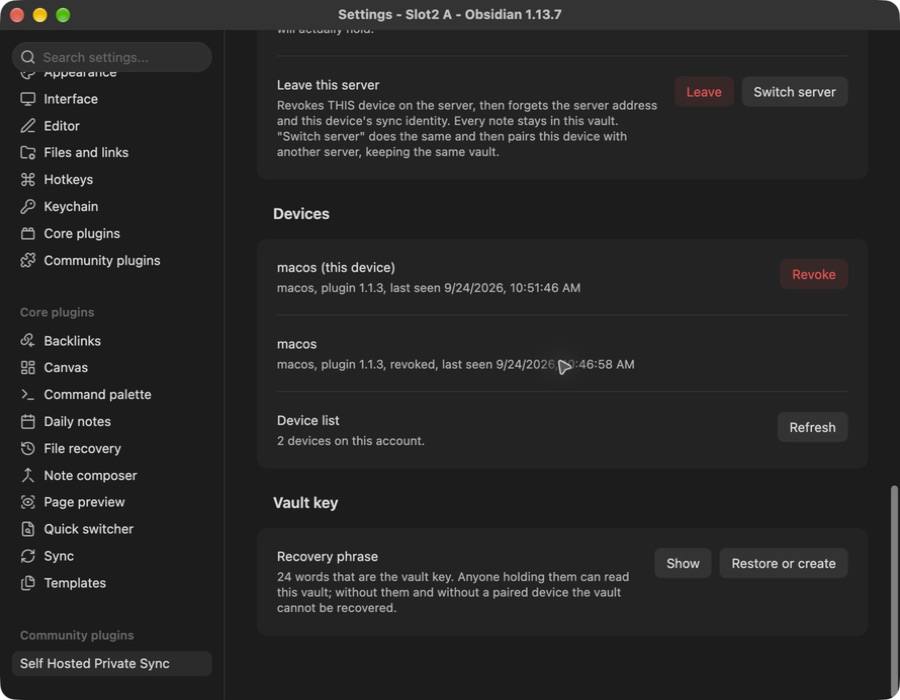
The device list initially retained the old refusal until Refresh was pressed. That observed #142 display defect is fixed by clearing the old identity's cached list after enrollment and ignoring an older identity's late response or error; five focused regressions cover both cases and server changes. The screenshots above record the observed build, including the manual Refresh used in step 3.
For a manual bundle update, disabling and enabling the community plugin loaded the new code. Reload plugins refreshed the installed-plugin list but did not reload this running plugin. This validation made no changes to the user's usual Obsidian application or vault.
Fresh-install phrase recovery
A second journey used a completely empty synthetic vault with no enrollment
or vault key, on desktop Obsidian 1.13.7 and candidate bundle
7557e642f146659c8dfe3cf0e974f405d8ca904d6364898102ddaf5a92d3efed.
The native Restore or create form accepted the existing vault's 24 words.
Set up or recover then accepted the isolated server's setup token and
enrolled the new device using the restored key's proof. The UI reached idle.
All 327 files then present on the source device arrived with identical
SHA-256 hashes and 327 local sync records. Existing enrolled devices remained
available in this complementary test; the earlier journey separately proves
recovery after the sole active credential is revoked.
Words and token passed directly between the test UI and temporary automation memory. Neither was logged, written into evidence, or captured. The token field was cleared after submission. The surrounding settings screenshots in the guide are sufficient to locate these controls without publishing a secret-bearing dialog.
Together these prove retained-key re-enrollment and fresh-vault phrase recovery on desktop. The actual Leave check follows below; switching every device to another server and phone recovery remain distinct checks.
Current switch confirmation
The current bd68df43… bundle opened the Switch server warning in the recovered
synthetic vault while other test devices remained enrolled. The guide's new
capture is cropped from that actual dialog. Selecting Cancel returned to
the paired settings. The user subsequently authorized actual Leave for this synthetic recovered
device. With the same bundle, the Leave confirmation was submitted through
the native UI. Every one of the 330 files then present retained its exact
SHA-256. The device ID and server URL cleared, file records became empty, and
the feed cursor reset to zero. Settings immediately showed not paired and
Set up or recover; Show remained enabled for the retained vault key.
No phrase was opened or captured during this test.
The other enrolled desktop's refreshed Devices list showed the tested device
revoked, the three other active devices still active, and the earlier revoked
device still revoked: five entries total, three active and two revoked. This
proves this single-device Leave path. It does not stand in for a complete
migration to a different server. Raw before/after hashes and safe metadata are
in 142-leave-current-baseline.json and 142-leave-result.json.